About
I really enjoy asking people, how do you define success?
I don't expect an immediate answer, but I find it usually sparks an intriguing discussion.
I've also worked through this answer a lot for myself.
I remember driving home from work in March 2020, during the peak chaos of COVID. The graphs for infections and deaths were growing exponentially. They just kept going up, and we were still going into work to train for an upcoming Western Pacific deployment.
In the meantime, I was making a pile of food, water, and camping supplies in case we had to relocate to the Olympic Mountains in my old Jeep. I figured people can last for a few weeks without food, but if the water treatment plant was unstaffed or power went out, population centers could be pretty unsafe in about 72 hours. On a lighter note, I was hoping to do some camping and fishing on the weekends anyways.
Having driven home from work, I was sitting in the car in the driveway, considering our fragile existence. Then I started reflecting on the ~30 years of my life to that point. If those graphs didn't stop growing, I would likely die soon.
Had this been enough? Childhood in Ohio, boating on Lake Erie, football, wrestling, tennis. Watching Toledo take on '08, watching cornfields around our house turn into subdivisions. Then leaving, Naval Academy, yelling, training, bonding. Ships, submarines, helicopters. My first Christmas away from home at the holiday markets in Germany, travel around the world. And then after graduation, MIT, nuclear training, shipyard life. Now on a submarine out of Washington State heading for Guam.
I had experienced a good amount, sure, but had I given anything back? Had I "lived deliberately" and "sucked the marrow out of life" as Thoreau desired? Had I added any value to the world? Or was I just a drain on the ecosystem, a consumer rather than a producer, as my dad might say? And then I had a thought about how to think about this (pretty meta, right?).
Some days later, I was sitting in the officer's study with my friends after lunch, and I wanted to hear their thoughts. I wanted to hear their perspective on this concept. So, I did what was common in that training area: I grabbed a dry erase marker and a whiteboard, and I started drawing.
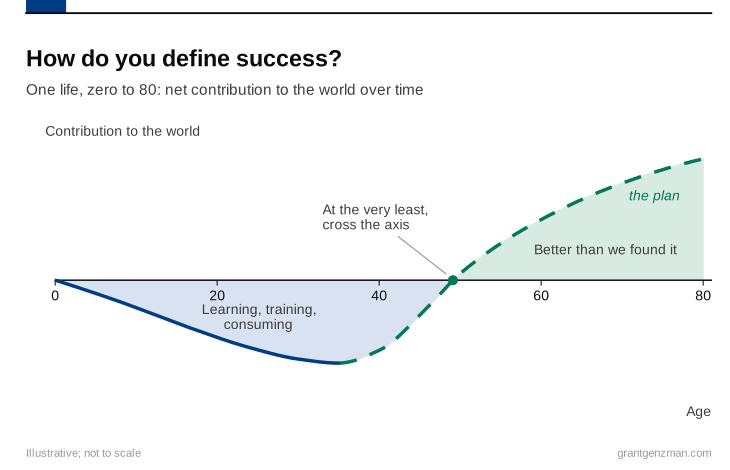
I was thinking about life like this: Graph your life from zero on the left to whatever is statistically the average lifespan for today—we'll say 78—on the right. We can round to 80. 80 years. From zero years to 80 years, left to right. And then you mark off the seasons of your life. You've got 20 years old, 40, 60, 80, optimistically. That's on the X axis, time.
Then on the Y axis, you could graph, of course, many things. But in this situation, we'll graph contribution to the world. How you define that, I believe depends on the person. I adjust the definition with each season of life. But generally speaking, contribution to the world.
How does that graph look over time? It seemed to me, sitting there at about 30 years old, that the first probably two decades of my life had been mostly training. I was learning how to be a kid first, then an adult, a human—how to survive. Also learning things in school like language, science, math, engineering, philosophy for 12, 16, 18 years.
After that, more training: learning how submarines and nuclear reactors and the Navy works. Optimistically, spinning up a flywheel such that it has enough inertia to go off and do great things. But all that time consuming; using oxygen, water, food, energy, electricity, people's time, effort, attention. Just taking in all these resources, with the providers and me hoping one day I could give back something more. A return on the investment.
But if you sit there at ~30 and plot consumption on this life-graph, it appears very negative. It looks really bad. It's just going down and maybe—well, maybe we bring some joy to other people, hopefully like our families and friends and teachers/leaders potentially—but the sum of the inputs and outputs of most people at that time seemed basically negative.
This overall is not necessarily a positive thought, though it seemed like I was still gearing up for the big thing. But if I were to go away at 30 years old due to COVID, I'd be pretty much leaving what seemed to be a negative contribution to life. That made me feel like crap.
Nowadays when I ask people what their definition of success is, I get different answers.
In business school, they often thought I was talking about a number.
When I'm with my family, they often think about growing the family, having kids, growing old with them.
In the Navy, it would have been about improving the lives of your people and maybe achieving rank.
Over beers with friends on a Friday night, it could be sailing around the world, traveling to all the countries, or leaving a legacy.
When I'm asked this same question (inevitably in response to my inquiring to others), this is the best answer I can give: I want that life-graph, before I go away, to be as far in the positive as I can get it. At the very least, I need to cross that x-axis and have my time on Earth be spent in such a way that I can leave it better than I found it.
I'm not quite there yet. I still have work to do. Follow along here for the journey.
These days that work lives at the intersection of AI, energy, and national success — building at Hungry Machines and organizing thoughts in the essays here. The newsletter is the best place to follow along.