AI in Life, Work, and Energy
Perspectives on where AI is taking individuals, companies, and the grid
I’ve been building an AI-native startup full time for a little over a year, jumping headfirst into AI and energy. These are perspectives based on recent conversations, talks, and essays. Part 1 is about people: how individuals should think about AI in their lives and their work. Part 2 updates my earlier notes on why the cost of using AI converges with the cost of electricity.
Part 1: Perspectives on AI in Life and Work
For Individuals in Life — Be Prepared for Whiplash
How do we compare to AI?
How do humans become intelligent? How do we learn? Well, we do things. We make mistakes, observe the process and results, and remember many cause-effect patterns. Over time, our memory of these patterns gives us some understanding of how the world works, how to communicate, and how to accomplish tasks, among other things. At first, we have to learn things for ourselves (e.g. the stove is hot, sometimes). In less painful situations, we can read about the experiences of others to understand the patterns they saw in the world, and then we can adopt those patterns for ourselves. Five senses collecting information over some decades gives us a good enough model for how the world works that we can go out and live in it alone.
AI learns the same way. Explore how the models work and you find that they are essentially pattern-matching machines. But the computers today can build their models faster, over vastly more data, find more patterns than we can, and retain them with a longer and more reliable memory. Most people have seen the results of training models on languages (large language models, LLMs), but we also can use sensors to take in vision, sounds, temperature, pressure, and various other aspects of the physical world.
Here is a thought experiment: Suppose you could record twenty or thirty years of one person’s sensory life—every sight, sound, touch, taste, and smell—and train an AI on it. Let the computer match cause-effect patterns over all of that data. How different would the result be from human intelligence? I don’t yet know the answer. But I increasingly think it may be “not that different.” If experience is data and learning is pattern matching, then one of the things we thought made us most special is a process, and that process can be run on other hardware. That may be the source of intelligence, but what about its application to tasks?
Specific tasks, general tasks, and volume
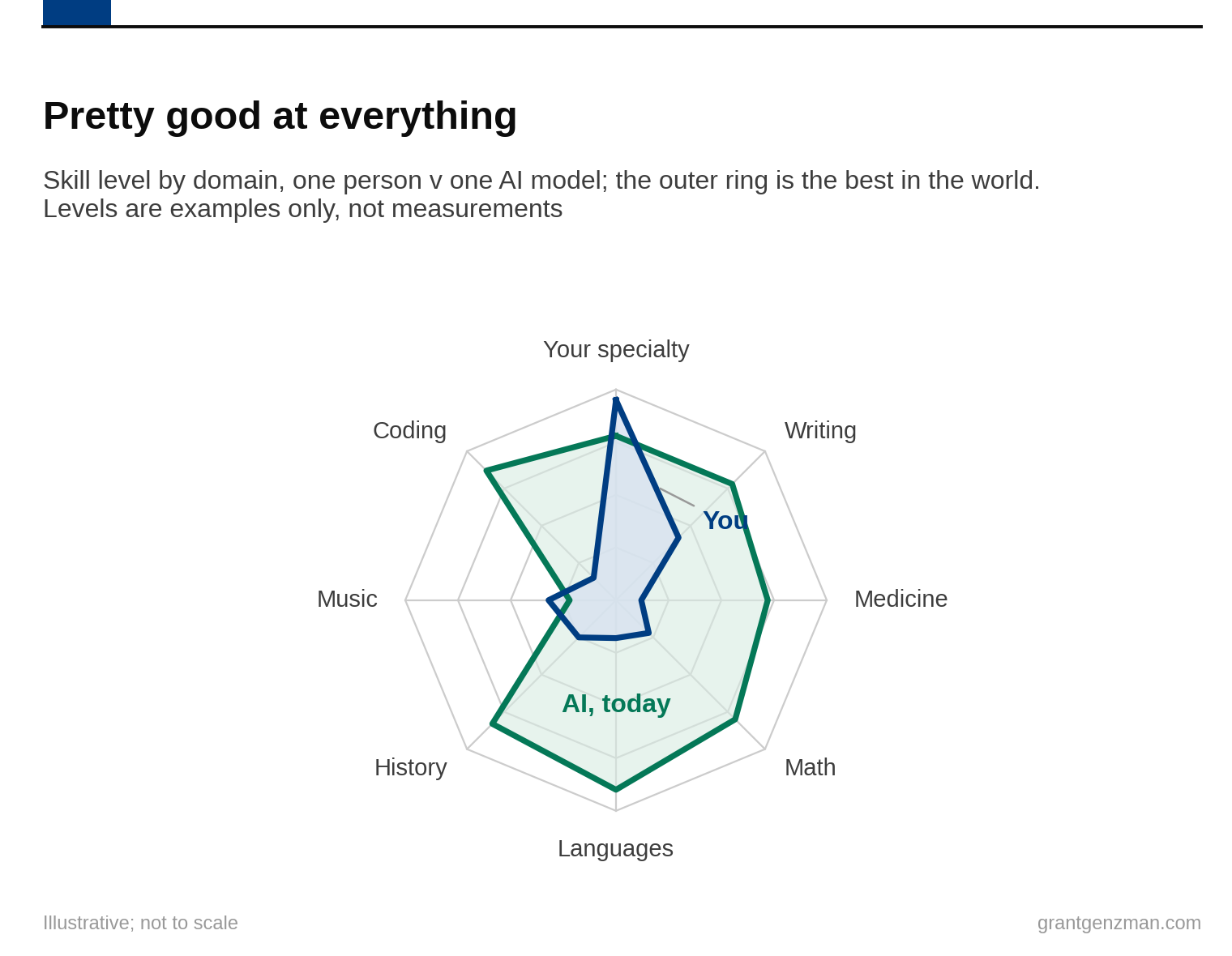
When people compare AI to human output, they almost always compare on a single task, and it is usually one they are very good at. They may even be trying to get it to do the exact tasks in their job—their specialty—better than they could. They are unconsciously matching generalist AI up against the humans who have specialized in that set of skills. It’s like asking AI to compete in a match against the humans’ best player—the one all the others seek out for advice on that specific game. Unfortunately, such framing hides most of the benefit of these new tools and makes people walk away thinking “AI is not that good.” Instead, we should broaden our comparison three ways: specific tasks, general tasks, and volume of tasks.
Start with a single task. For any skill, there is a quality spectrum with some number of people at every level. In art, you may have Picasso at one end and at the other end are people who have never picked up a brush. In writing literature, maybe you have Hemingway, Jane Austen, and Shakespeare at the top, while on the other side live many folks who stopped writing after high school or college. If you are a specialist or an expert and you sit in the upper half of the distribution for your skill, I would not expect AI to outperform you immediately. But if you have never done a certain task and you ask AI to do it, it is probably already better than you.
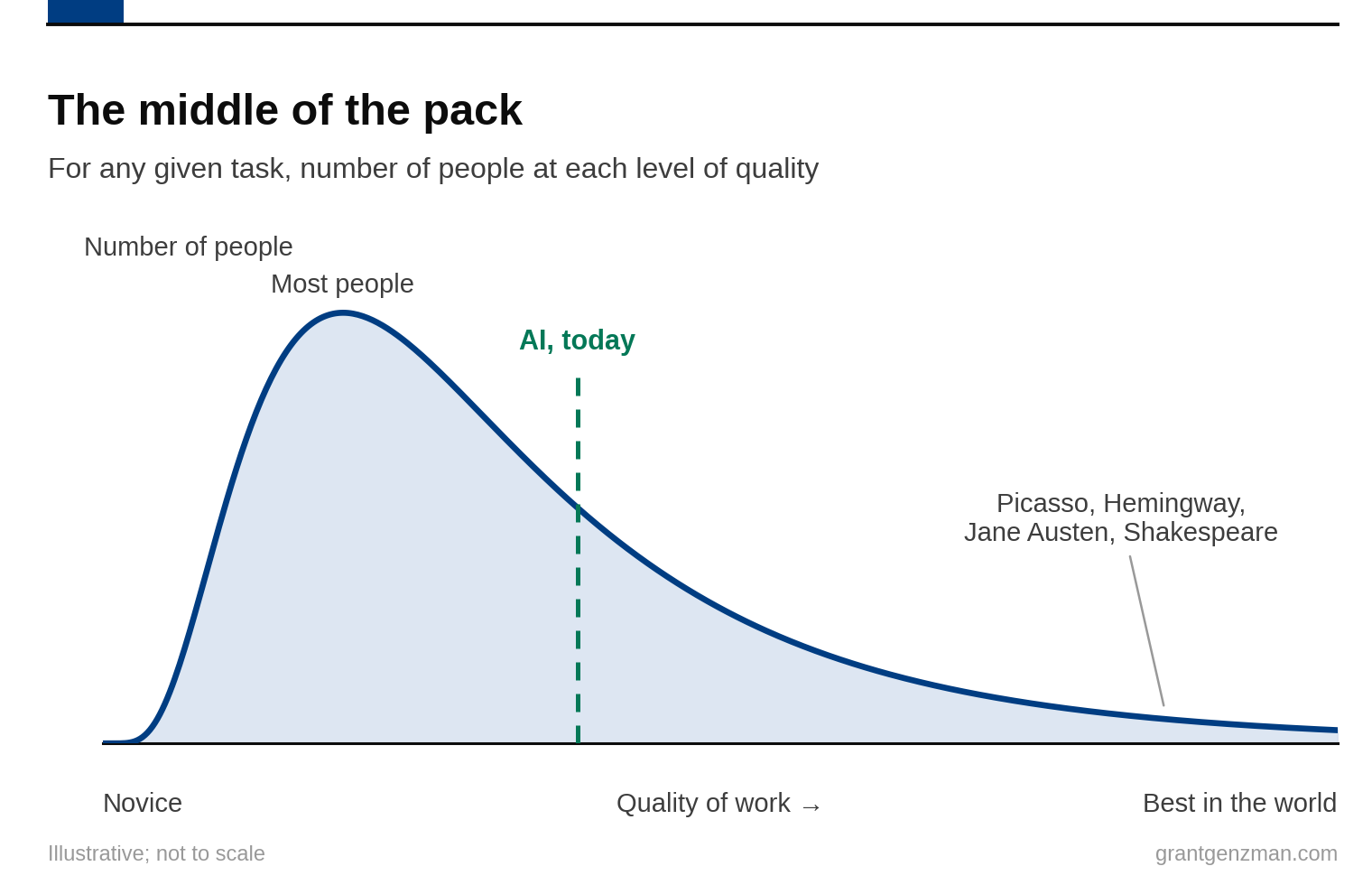
This takes us to general tasks. AI may not be the best in the world at any one thing. But if you give it 100 different tasks, it will be pretty good at most or all of them. Most AI tools of today won’t be the best at any task—they aren’t yet developed to be specialized—but a single tool will likely sit comfortably in the competent range of essentially every distribution at once. It may not be the best at any one thing, and yet it is already better than any single person at everything. Using a frontier LLM today is like walking into a room of hundreds of PhDs (all in different areas of study) and asking your question.
Finally, volume. Let’s say you write blog posts for your company at work. You are the best blog post writer in the company. You can clearly and concisely communicate the company offerings and their value. You write one post per day and it is better than AI every time. Or maybe you write 100 lines of code or five social posts per day, and each of those is better. But what happens when you try to 10x or 100x your output? Humans might be able to complete single tasks better than contemporary AI tools, but AI can write a thousand newsletters, social posts, lines of code, summaries, or blogs better and faster than any human can. The compelling version of the future is not AI doing your one thing slightly worse; we still need and want humans showing off their superior skills! But when it comes to volume and speed, AI is able to create results that are quite good at a scale that is simply unheard of for humans. Unfortunately, they’re also improving faster than we are.
The chess lesson
As we venture into this future, wondering how we compare to AI, there is a classic example of how this goes: computers playing chess. Humans have played chess for a very long time and we started training computers to play with us, much more recently. If you plot human skill over the long history of chess-playing, you’ll see that the best of us did improve over time. The top-tier players improved gradually.
For hundreds of years only humans could play. Then computers were invented and for decades still, they weren’t competitive beyond intermediate. But they were improving fast. Serious players would have ignored them for a long time until, seemingly suddenly, the computers were beating advanced players, then beating professionals with lower rankings, and then soon enough no human could beat the computer any more. Serious players saw decades of certain winning, a few years of genuine competition, and from now on, decades of losing.
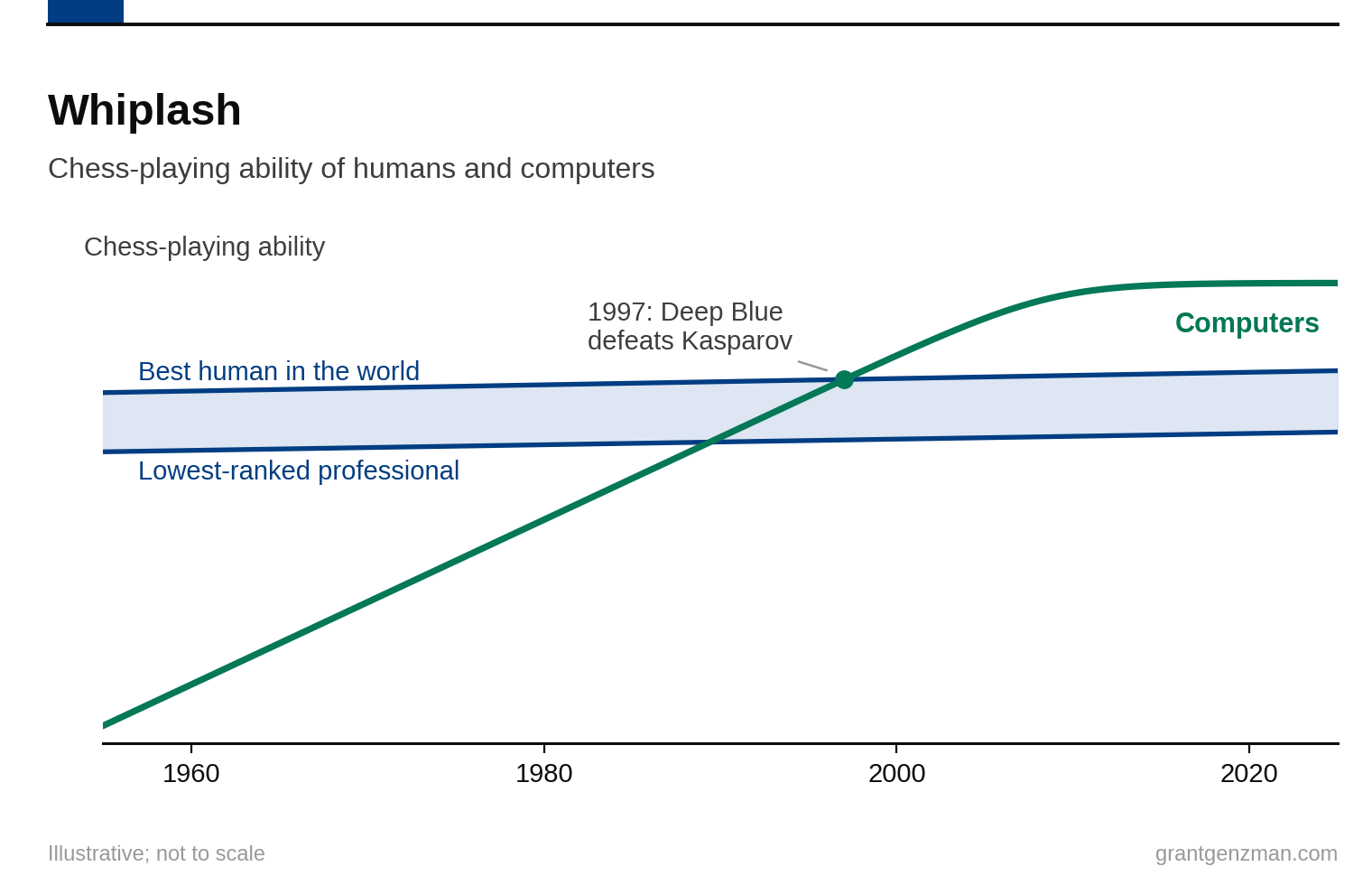
At this stage of history, that story is not about chess. The story is about the shape of learning curves, the pace of improvement. For many decades, computers could not do what we did. At any task, the lowest-ranking human beat every computer. But computers can improve very fast and, importantly, very consistently. When a capability is improving on a regular cadence, it spends most of its history improving invisibly, below our rather thin spectrum of concern, potentially below our perception of change. And then suddenly it blows through our target skill range—professional to world champion—almost at once. We need to be prepared for whiplash.
More than LLMs and chat interfaces
Most of the examples above involve text, because that is where much of the public conversation lives today. But AI is much more than chatbots and LLMs.
Voice is already here. Speech-to-text and text-to-speech—even speech-to-speech models—are good enough today that talking with your computer is no longer science fiction. You can download a personal Jarvis and run it yourself, even on your own consumer hardware. Computer vision applies the same pattern-matching concept to images instead of words. Scheduled AI workflows are generally underappreciated: I wake up to customized morning news summaries, an automated review of yesterday’s server logs, and SEO and content performance metrics with new opportunities identified for four sites, all texted to my phone. And none of that requires a cloud provider. What would you have automated workflows do for you? Voice, vision, and scheduled automation can all run on-site, privately behind your own firewall, at your own home or business—local AI at the edge.
Go a layer deeper and large language models are a smaller subtopic under the much bigger umbrella of artificial intelligence and machine learning. Language—all the human languages plus all the coding languages—is only one type of data. I am building machine learning models that work on temperature or charging data and home electric loads. A robot that sees, listens, bumps into things, and learns from all of it is collecting the data foundation for another kind of model again, physical intelligence. The real unlock is parallel compute: we went from doing math one equation after another on a CPU to doing thousands of calculations at once on a GPU. Applied to natural language in the late 2010s, we got GPT. More recently we applied it to code. Light, sound, temperature, motion—the amount of data on which you can build models is huge, we just need to keep working.
For Individuals at Work — It Is Only a Matter of Time
The AI-Native Company
I’m obviously very excited about this. Why am I excited about it? We’ve already seen that it is easier to build products. You can go use tools like lovable.dev, v0.dev, even ChatGPT and Claude now. You can describe a new product, website, app, anything you want and they should be able to code a first version of it. You can build some really nice things. But it is still vibe-coding, right? At this point a lot of people can do that. And teams of the past could build code, though certainly not as fast or as cheaply. It’s extremely exciting to produce new ideas. But that’s increasingly not the most exciting part of AI. What gets more exciting is the operational workflows that can be improved, more than just trying to build a better mousetrap.
What if you could build the factory that builds a thousand mousetraps in the same amount of time that it took you to build a single one before? Now you have a structurally better operation, a structurally better company, your financials are going to look better. Even if you build the same product that somebody else is building, but you do it at a tenth of the cost, now we start to get to the point where people are talking about abundance. They say “we’re going to be living in a world of abundance.” “Nobody will have to work.” “Everything’s going to be cheap.”
Do I think that’s in the realm of the possible? Actually, yes. But in a way further timeframe than anybody wants to admit. Everybody currently fighting around that discussion is talking past each other based on misaligned timing assumptions. Does it happen in the next five years? No. We’ll probably have more issues in the next five. But in the long run, I think it’s reasonable and possible. But how do we get there?
What do humans actually do at work?
We have already mentioned some common refrain around AI: “Well, it can’t do X, Y, or Z.” Usually people are talking about very specific skills. Their perception of performance depends on the task.
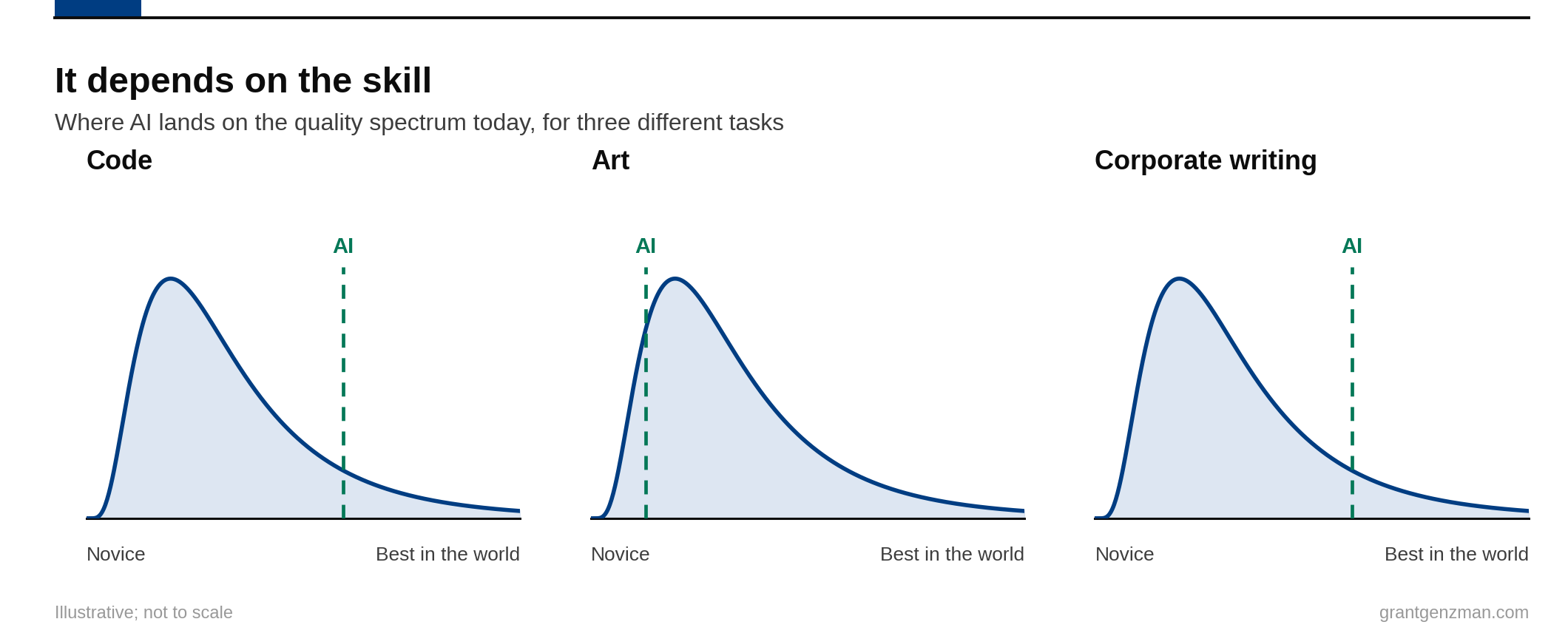
Let’s again look at a couple of different skills. First, coding: Can AI code? Let’s again plot a performance spectrum with skill on the x-axis and number of people on the y-axis; a distribution curve. Novice to expert. AI for a long time was on the novice side, first unable to code, then finishing lines when the user pressed “Tab”, and eventually writing snippets. Even three years ago, it couldn’t really code. Today, it writes out whole repositories, tests the product (website, app, algorithm) before claiming to be finished, and works extremely fast. You would be hard pressed to find someone better than AI. Better quality? Probably. Higher quantity? Almost certainly not. Writing basic code, like building a webpage, AI can beat a hundred developers that all sit in the “average” range of the skill distribution. AI lives on the high side of the performance curve for writing code today.
Let’s take another skill: Art. And what do I mean by art? Things that convey or evoke emotion, beauty, intrigue. Something that’s stimulating to humans with well-developed brains. There’s still a spectrum in performance, low to high. Where do we think AI lives today? I believe it’s over on the low end. For the LLM, maybe “creativity” could be from hallucinations or a change in the temperature setting of the model. But I wouldn’t necessarily call that intriguing creativity. For the most part, it’s not very good at that yet.
How about writing? Not literature in this example, but rather the corporate blog post. Not creative, artistic writing. Writing for when we want to convey basic information in a very clear manner, understood by as many people as possible. For this task, AI does really well. It is on the high side of the distribution, not only in quality but certainly speed and quantity. I have documentation pages and explanatory blog posts on my company sites, and I’ve written none of them because it does a better job than I do. It’s often clearer, it doesn’t assume background knowledge as much as I do, and it’s not lost in my own thoughts. AI is just better at achieving that specific goal of conveying basic information, simply, to the most people.
What tasks are most common in companies?
Let’s change the frame of reference. So far, we have considered what individuals do. Let’s also look at what companies need done. If you consider most corporate jobs, roles, tasks, skills—where do they land? My thought is they land somewhere more like copywriting and coding; communicating task assignment and completion via email and Slack, maybe some presentation slides. Most corporate workers don’t spend a large percent of their time working on creative tasks or creative problem solving. Maybe ninety percent of many jobs seems historically rather mechanical.
For a very select few, their work is creative problem solving: the CEO, the chief strategy officer, the board. But most people’s “work” is showing up to meetings and participating, which is just kind of connecting these creative things. It’s work based on administration or bureaucracy. It’s the connective tissue between these creative tasks, so the people in higher roles can be aware of what’s going on everywhere else.
Unfortunately, the need for creative problem solving in many corporate roles is not very high. I did not find a need for a lot of creative problem solving while operating the nuclear reactor and power grid on submarines. In fact, I sometimes joke that if I were creative problem solving in that role, something was very bad. Instead, there were SOPs, there were workflows, there were procedures. My whole job was essentially to take an instruction manual, work through the procedures, and verbalize commands and steps over a microphone so that other people in the engineroom could do their follow-on actions. There was of course some decision-making involved in that, but passing information effectively was a huge percent of the role. That has been an important task throughout history, but the need for it is rapidly going away.
What tasks should we leave for the humans? – Also, Get off the X
There is a phrase for avoiding the spot where danger is imminent: Get off the X. If things start to go sideways, get out of the way. Given our exploration of the capabilities of AI, the jobs to be done in a company, and the skills required to do them, what are the things that AI cannot currently do? If you are building the AI-native version of your company, what work would you leave for humans?
I was reflecting on this while on a flight recently. I was drawing graphs of different skill distributions, considering where humans and AI land on each. If you are looking for skills where humans currently have a competitive advantage over AI, I would point to things like judgment, creativity, negotiation, and sales. Vision for the future. Agency—a desire to actually want to embark on a venture or complete a mission. Human connection and empathy, if there’s a human element in the product or service. I look at all these things and I think, “Okay, this is a founder.” Or these are leaders of the company. This is the CEO. Today, maybe like 10 people in a company of 100 need to do those things.
If the bulk of your role lands on the parts of the skill spectrum AI already covers, your job description is the X. The answer is not panic; it is movement—toward the other parts of the spectrum that AI cannot yet reach. Judgment. Creativity. Negotiation and sales. Vision for the future. Agency. Who does that list describe? Founders, leaders, owners of problems and builders of solutions.
That is part one of the case for entrepreneurship. Building something is the fastest training program in exactly the skills that will remain scarce. It can be difficult to practice judgment, agency, and decision-making from inside the machine. But you can practice all three by next Tuesday if you start something.
For Company Productivity — The Era of the Innovator’s Dilemma
Financials: Traditional company vs. AI-native company
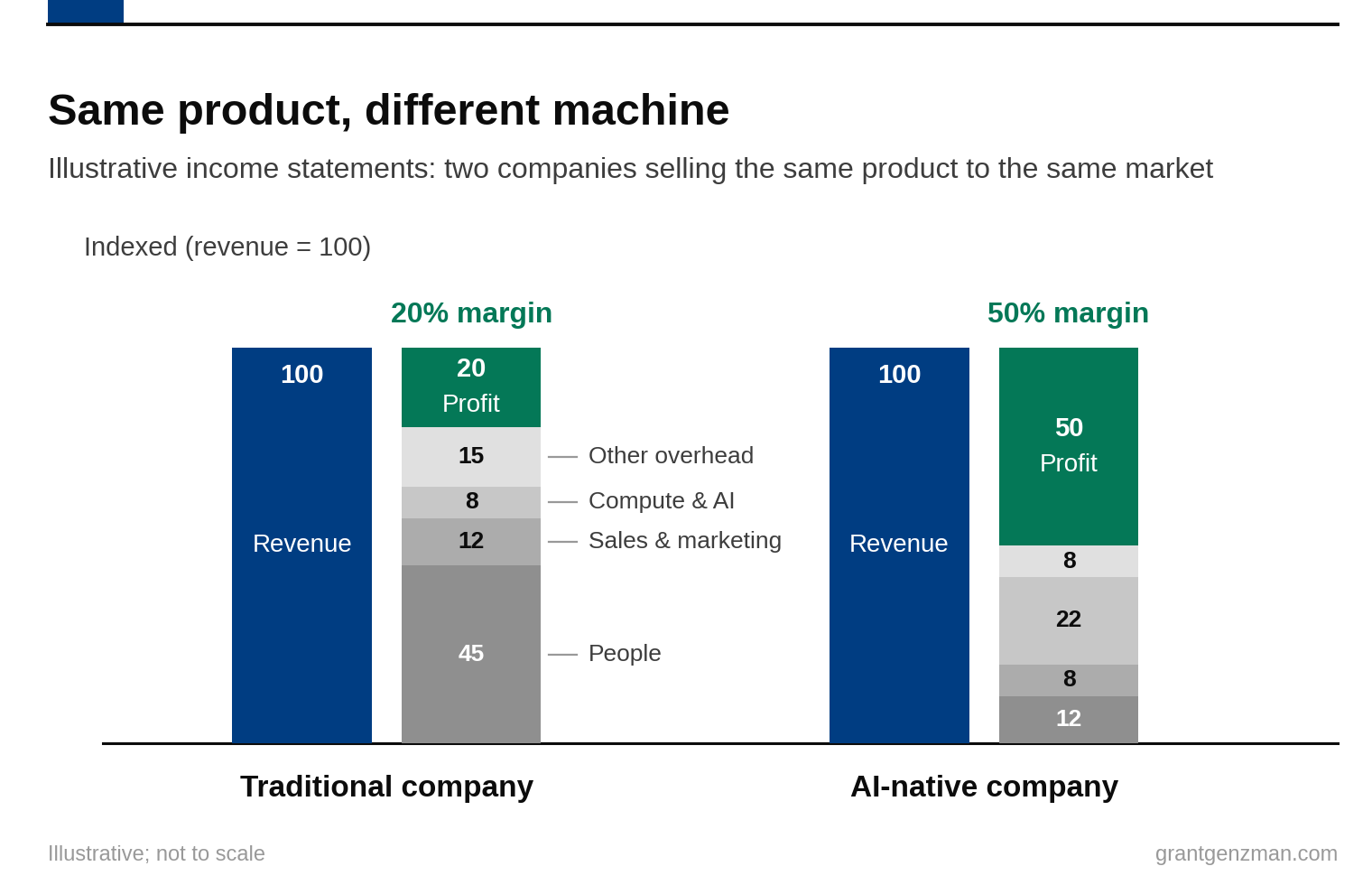
Now let’s look again from the overall company perspective. Let’s consider an income statement, where you have revenue and then you have expenses. We want to compare an old company versus a new, built-from-the-ground-up, AI-native company. Say your revenue in the traditional company is “100” and your total expenses are maybe “80,” so you’re making 20 percent profit.
Then here comes along a new competitor. Same product, same market, same customers. But built completely around AI. Not even “transitioned” over to AI, where the company has both AI and people in Slack, but they’re still talking in Slack. Or where they have AI recording meetings, but they’re still holding meetings. No, this new company has an AI-built product, fixed and maintained by AI, quality assurance by AI, delivered and distributed by AI. Communication to tie everything together is data over code, not people messaging each other. The leaders sit at the controls, spot-checking quality gates and making strategic decisions, then steering the ship and the AI machine moves smartly in that direction. Given the same headcount, this company likely serves more customers and does so at a proportionally lower cost (50%), yielding a higher profit margin (50%).
Future trajectory
This AI-native company described above may still employ the same number of people. Hopefully it does. But it is able to serve a larger market, serve more populations with niche needs in that overall market, offer substitute products at lower cost, grow faster, and maintain smaller overall expenses (by percent), yielding higher margins. After the humans contribute decision-making and judgment, the primary inputs are code and electricity. For now, this type of company can offer digital products; in the near future, robotics enable this type of company to produce most physical products.
As we again consider our role as humans, it is important to employ us well. We should be reserved for the tasks that only humans can do; we should lean into the competitive advantage. But when it comes to tasks that AI can do well already or soon, it may be important to remember that human capability in many of these skills has basically plateaued. Humans are also getting more expensive over time—cost of living, cost of food, healthcare, education. Conversely, AI is today as bad as it will ever be and it’s becoming more capable and less expensive every day.
Back to comparing companies: If one company offers the same product at a lower price, or offers more customization, or has faster turnaround times on product improvement, which product does the consumer buy? If one company has better margins and faster growth, which company gets the investment capital? In the long run, which company wins?
The Innovator’s Dilemma, everywhere at once
This is also the quintessential Innovator’s Dilemma.1 While an incumbent serves a product, a new entrant comes in from below with a product that is cheaper and initially worse. They don’t feel like much of a threat, given their size and the lower quality. Over time, the entrant improves quality while maintaining the better cost structure. It keeps chipping away at the lowest-need customers, working upward in quality until it serves a large part of the incumbent’s market at a fraction of the cost. Because the incumbent never disrupted itself, investing R&D in the new product, someone else did. The classic version plays out industry by industry, staggered with niche players in each.
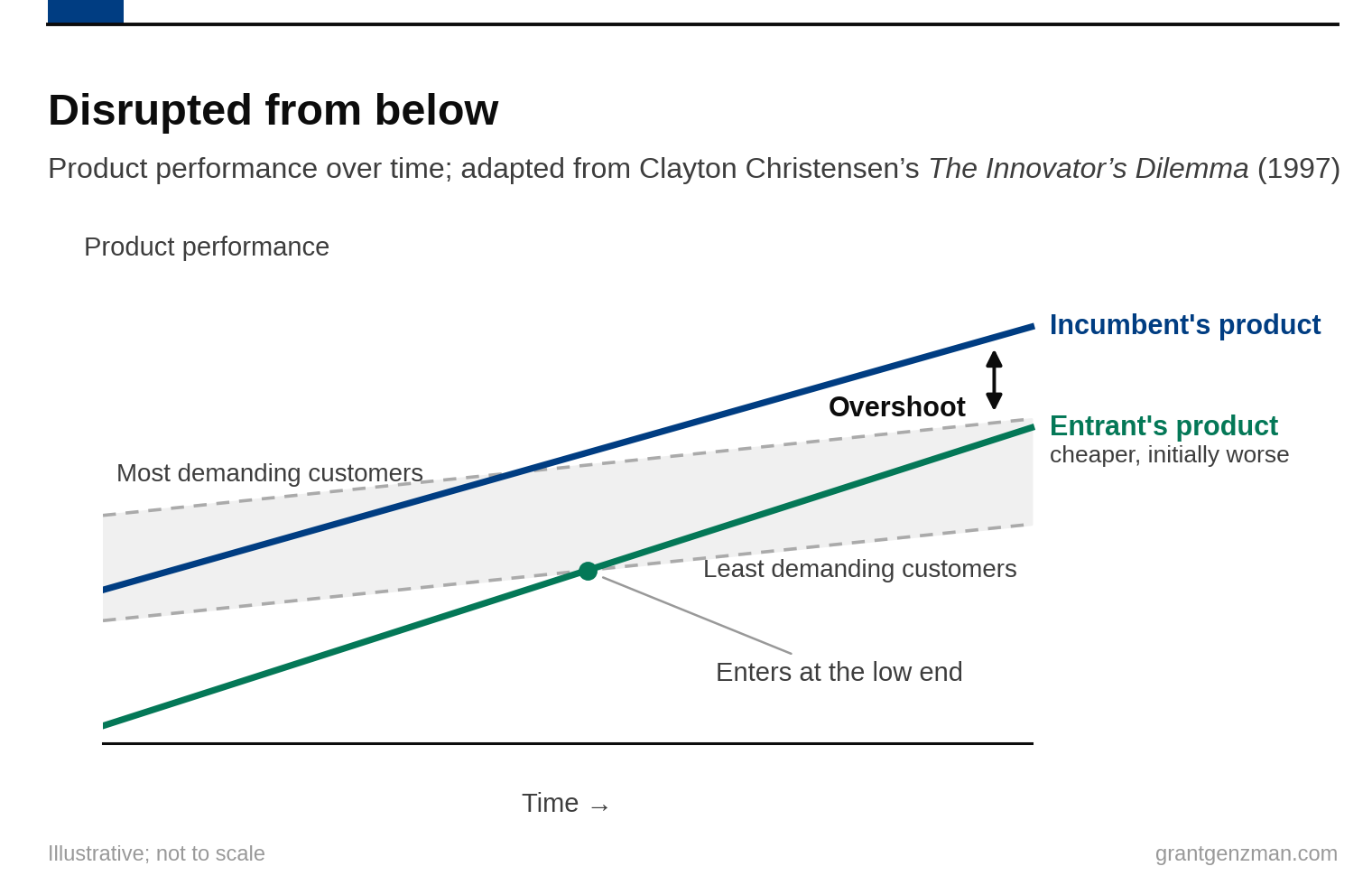
What is wild about this moment is that it could be similar disruption everywhere, simultaneously. Most companies run on essentially the same foundation—email, chat, documents, meetings, all in natural language. Probably half of business operations is just people communicating with each other, and that layer is what AI absorbs first. The disruption does not have to learn each industry from scratch; it comes in through the communication backbone that every industry shares.
The Case for Entrepreneurship, and A Misjudgment of Risk
We have already talked about how entrepreneurship can teach valuable skills, and we have alluded to it now being easier to build things. The barriers to entry for the adventure of entrepreneurship have never been lower. But society has conditioned us to believe that entrepreneurship is risky.
That said, I do wonder—and this is partially a societal issue that I’m concerned about—I wonder if that is changing. We can look again at that traditional company versus the new, AI-native one. Same product, same revenue for now. Lower margins for traditional, higher margins for new.
You get a role at the older, established company. Staying at this company—the old school company, trying to transition to using AI as tools, or not even trying at all—might actually be riskier than trying to build one or two of these new AI-native operations. But it’s hidden risk. Working at the incumbent doesn’t feel like the same level of risk as going off to build the challenger. And society still talks about building the new thing as being risky.
But I wonder if the actual long-time-horizon, risk-adjusted returns are better with the building. We have already made a case that the incumbents are a ticking time bomb. Given all the other comparisons we just made; given the questions: What is AI already good at? What are the things that you need done in a company? But the transition is difficult.
Many people reasonably say “I can’t leave my job” or they worry about trying to “use AI better” so that they aren’t replaced. After this discussion, I wonder if the main risk at a well-established company is less that you lose your role and more that the whole company goes under. Some team of five or ten people builds the same product for cheaper and delivers it for cheaper. You didn’t do anything wrong, but the customers went elsewhere. Staying on the slowly sinking ship may be higher risk than working to build your own.
The status quo likely sticks around for a few more years. And everything is company- and industry-dependent, of course. But generally speaking, this is the era of small teams and niche products, and the incumbent revenue streams are likely under attack. The new players can do more, faster, and with more agility. Maybe that should be you.
AI in Society — Risk of Disaster or Opportunity for Abundance (the Timescale Matters)
Now that we have worked through disruption of both corporate roles and the companies themselves, what does that mean for the future? Will everyone lose their jobs or are we looking at a future of abundance, where nobody will even need one?
Both, probably, but at different times. As far as AI goes, the genie is already out of the bottle and there is no putting it back in. Nor would we probably want to, on the whole, but we will need to adapt a bit.
In the long run, the optimistic vision does seem likely: robots that mine for materials and automated factories that build the products, robots that farm the fields and autonomous vehicles that deliver the food, machines that improve healthcare diagnostics and treatment, AI pattern-matching making new discoveries, and even computers that take care of our most menial tasks.
But in the short term, if we refuse to adapt as the world changes, there will be speedbumps. This is true of companies and workers, governments and citizens. Even if we work on adapting but the world changes faster, we may find difficulty. Without specific answers, my plan is to jump into what’s new and learn as fast as I can. I would recommend the same.
If we bring the conversation above individuals and companies, at a high level, AI today is a newfound way to convert watts into intelligence, productivity, and value. Now the sky is the limit, assuming we can power it. On the international stage, to opt out would give any adversaries an open door to best us. Our species has succeeded because we’re intelligent—why do we think we’re not going to need more of that?
Part 2: AI Is Just a Wrapper on Electricity — The Role of Energy in AI
This part condenses and updates my November 2025 essay, “The Role of Energy in AI at Scale,” with data through August 2026. The thesis has not changed and the numbers supporting it are more stark.
Why the cost of using AI converges with the cost of electricity
For this section, we are concerned with the marginal cost of using AI. Considering the marginal cost means we are measuring the cost of the next (or most recent) unit produced, so any fixed costs are divided among that unit plus all previous units.
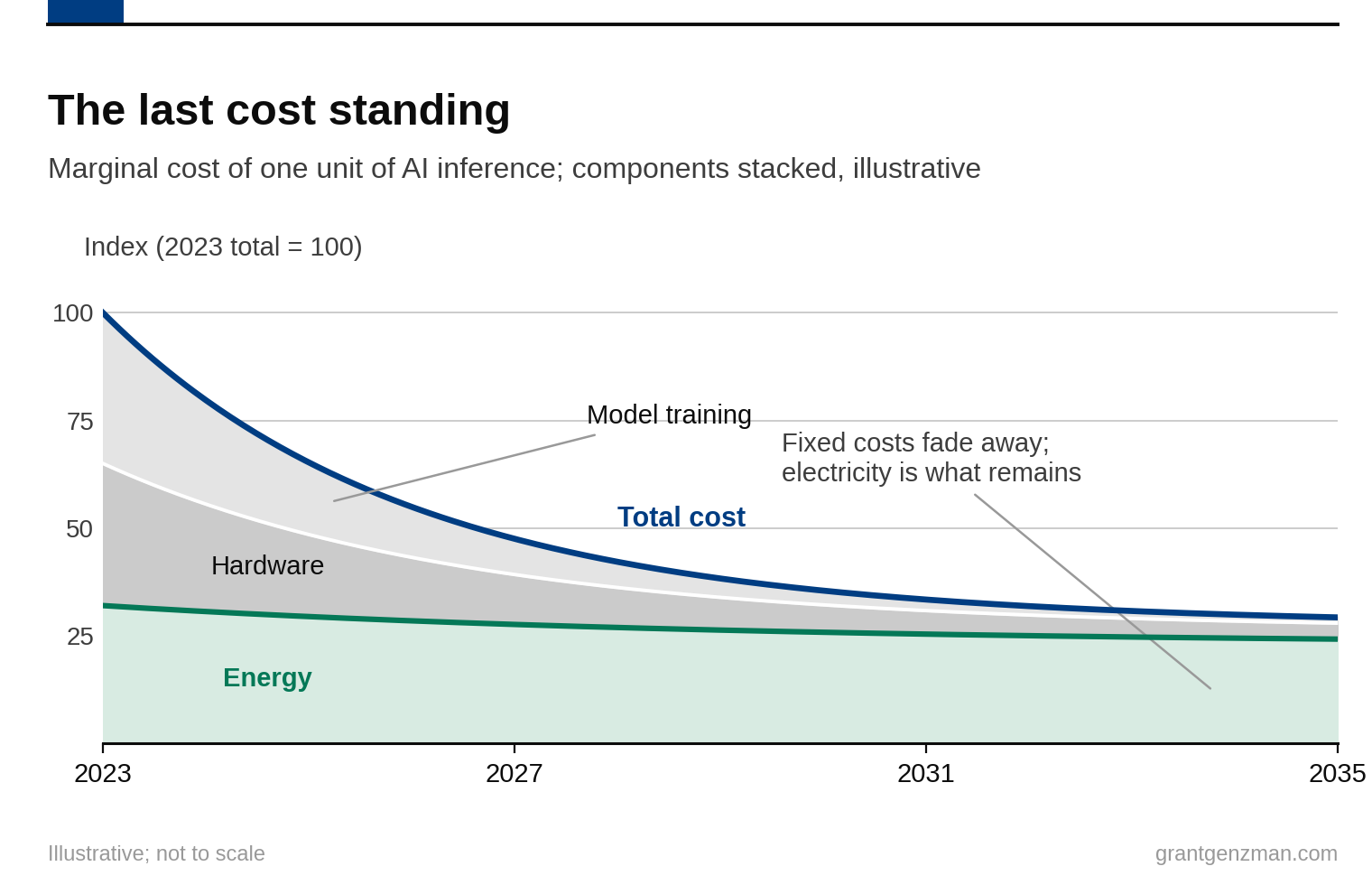
With respect to using AI, we are concerned with the electricity in inference—not training the models—so just what is needed when the user sends input, the hardware runs a very large number of parallel calculations, and the user receives an output. Today the big labs and datacenters price inference through subscriptions and API fees, and those prices reflect the large fixed costs behind them. But if we break down what actually goes into the cost of completing one task with AI, it decomposes into three components: the cost of the model weights, the cost of the compute hardware, and the cost of the electricity to run the calculation.
Two of those three are fixed, one-time costs. Training the model and building the compute infrastructure happen once, and then their costs are spread across every unit of usage afterward. As the amount of usage grows—and it is growing rapidly—the fixed costs per task shrink toward zero.
As a variable cost, electricity is paid according to how much the computers run, so the total amount of electricity used scales upward with the total amount of AI usage. In this way, as the total AI usage goes up, the marginal cost of having AI complete a task converges on the cost of the electricity to run the hardware for that task.
Free, open-weight models close the model gap
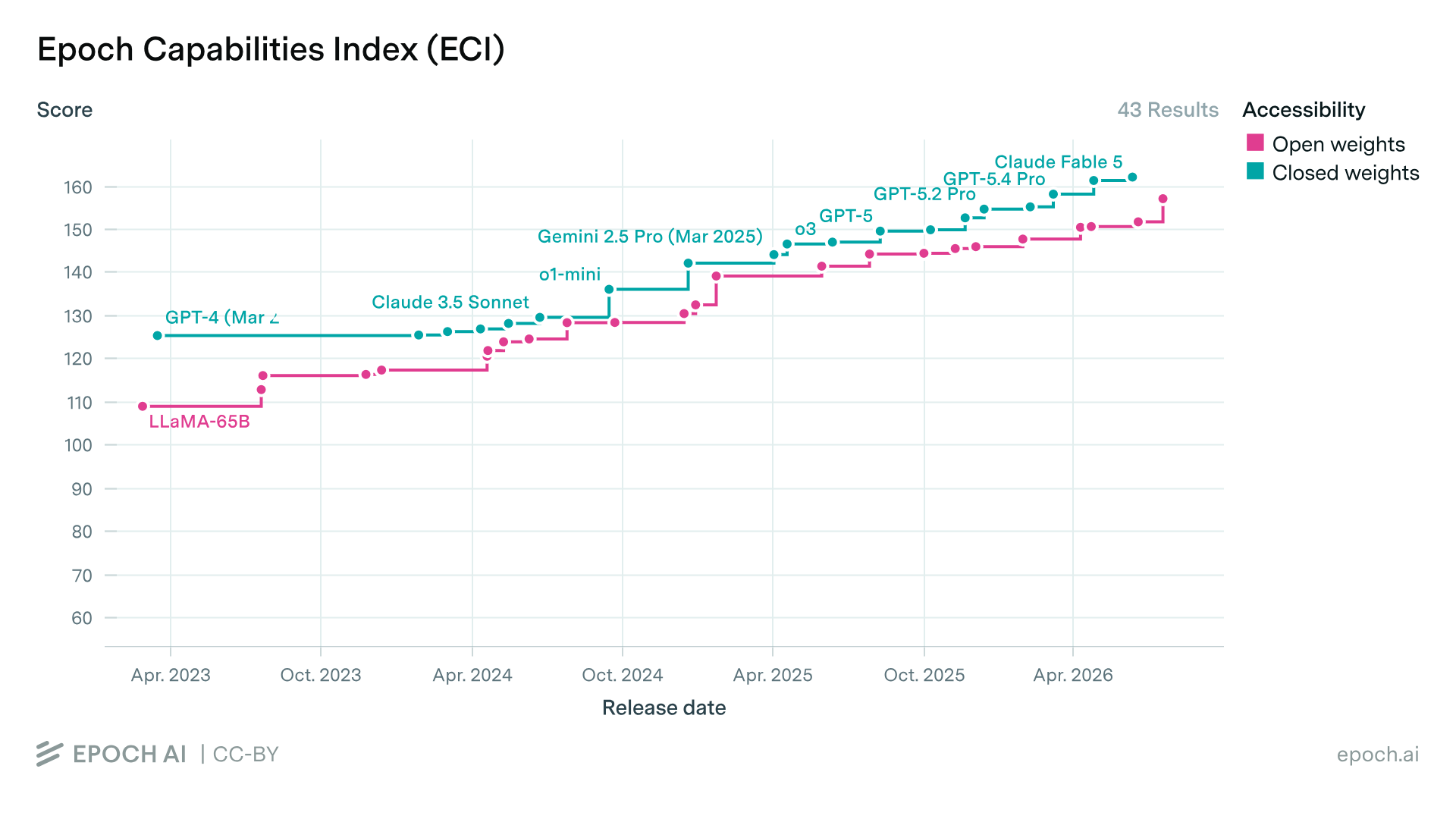
The model side of the equation is collapsing very quickly, because free open-weight models are increasingly high-quality. The open frontier tends to lag the proprietary frontier by only six to twelve months, and for a large share of real tasks the open models are already good enough. When a good-enough model costs nothing to acquire, the model term in the cost equation goes to zero. Then, what you are really buying when you “buy AI” is hardware time and watts.
Electricity is the cost that remains
Once initial training and hardware costs spread over time to nearly zero, the cost of power to run the equipment is what remains. The cost to run GPUs is a function of both the price of electricity ($ per kilowatt-hour, $/kWh) and the efficiency of the hardware.
As we have seen historically, we can expect that hardware efficiency will go up, which would reduce the amount of energy required to run it.
At the same time, while electricity prices have historically been steady, it is not clear what will happen moving forward. I suspect they will rise faster in the near term, but it is not clear by how much. This overall cost for electricity to run the AI inference hardware is what will drive the cost of using AI moving forward. Said differently: AI is increasingly just a wrapper around electricity.
The more electricity you have, the more models you can run, the more attempts you can throw at a problem, the more intelligence you can push at anything you care about. Quality of results starts to depend less on the size of your model and more on the amount of energy you can dedicate to the task.
Jevons paradox and the adoption curve
What happens to demand as the cost per task falls? Per Jevons paradox, when something gets cheaper and more efficient, we do not use less of it, we instead tend to use more of it. We find uses for the tool which did not make sense before, when it was more costly.
Compute itself is a great example—from a machine filling a building at IBM to a comparative supercomputer in every pocket. Take the actual adoption curve of personal electronics and edge devices, then add voice interfaces, computer vision, scheduled workflows, agents, and eventually robotics, and the growth of AI usage looks like the growth of mobile phones. But every unit of that growth pulls more electricity behind it.
AI at the edge is not science fiction – Another Innovator’s Dilemma?
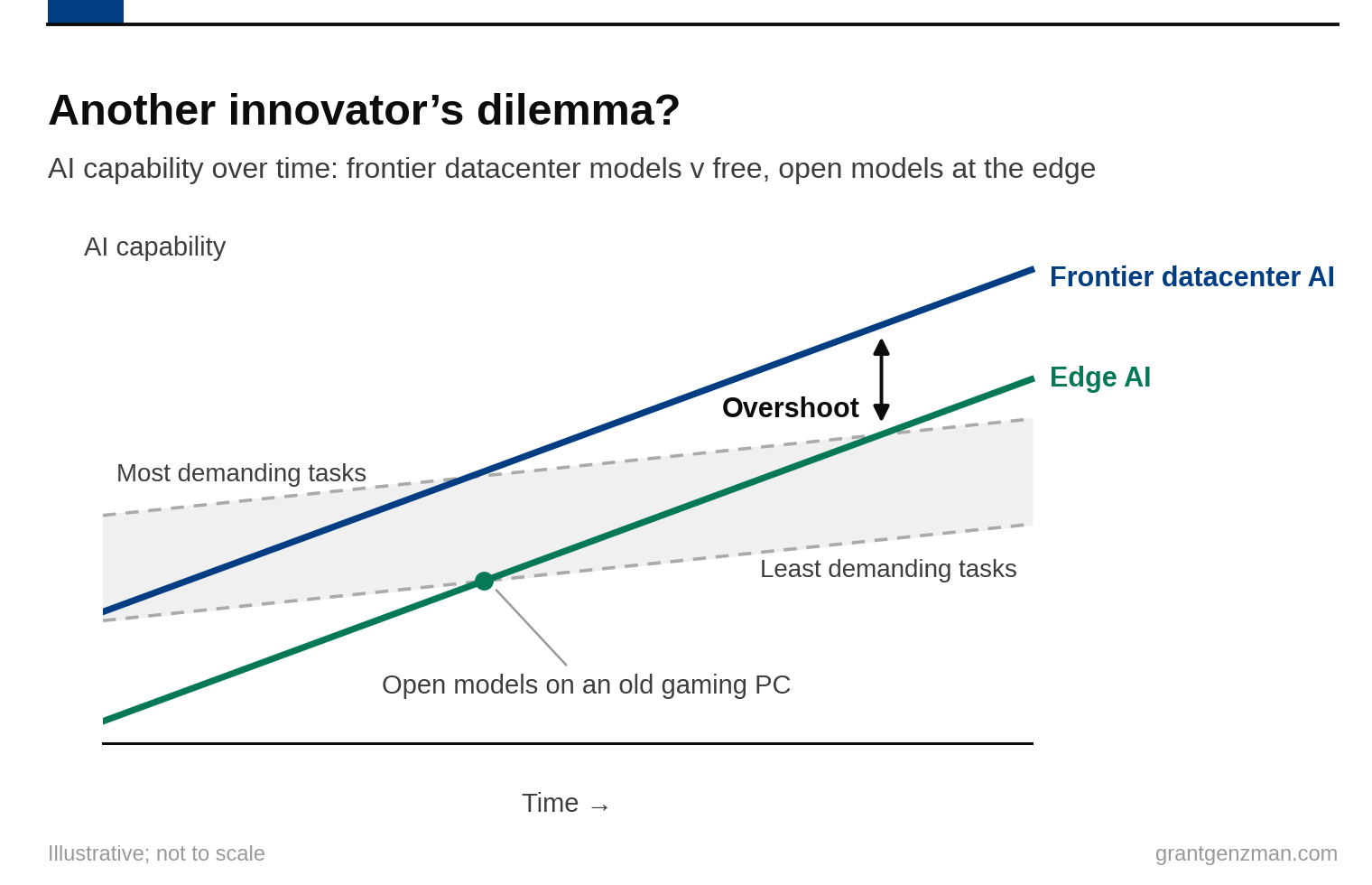
Already we are seeing small open-source models catching up to the recent frontier. With the release of model options like Qwen 3.8 27B and its variants, the capability of AI that can run on an old gaming computer rivals frontier proprietary models of about six months ago. One could go from a $200/month subscription with usage limits to unlimited use at comparable quality for the cost of a $1000 machine, plus energy.
This begs the question, when do people move toward edge compute? Could the frontier be gaining capability so fast that those offerings shoot past the high-end quality window that most demand is capable of absorbing? And from the lower end, do free, open-source, edge-device options rush in to run most of the AI of the future? When that happens, one would expect an explosion of use given Jevons paradox and traditional edge-device scaling trends.
Exponential demand, linear grid supply
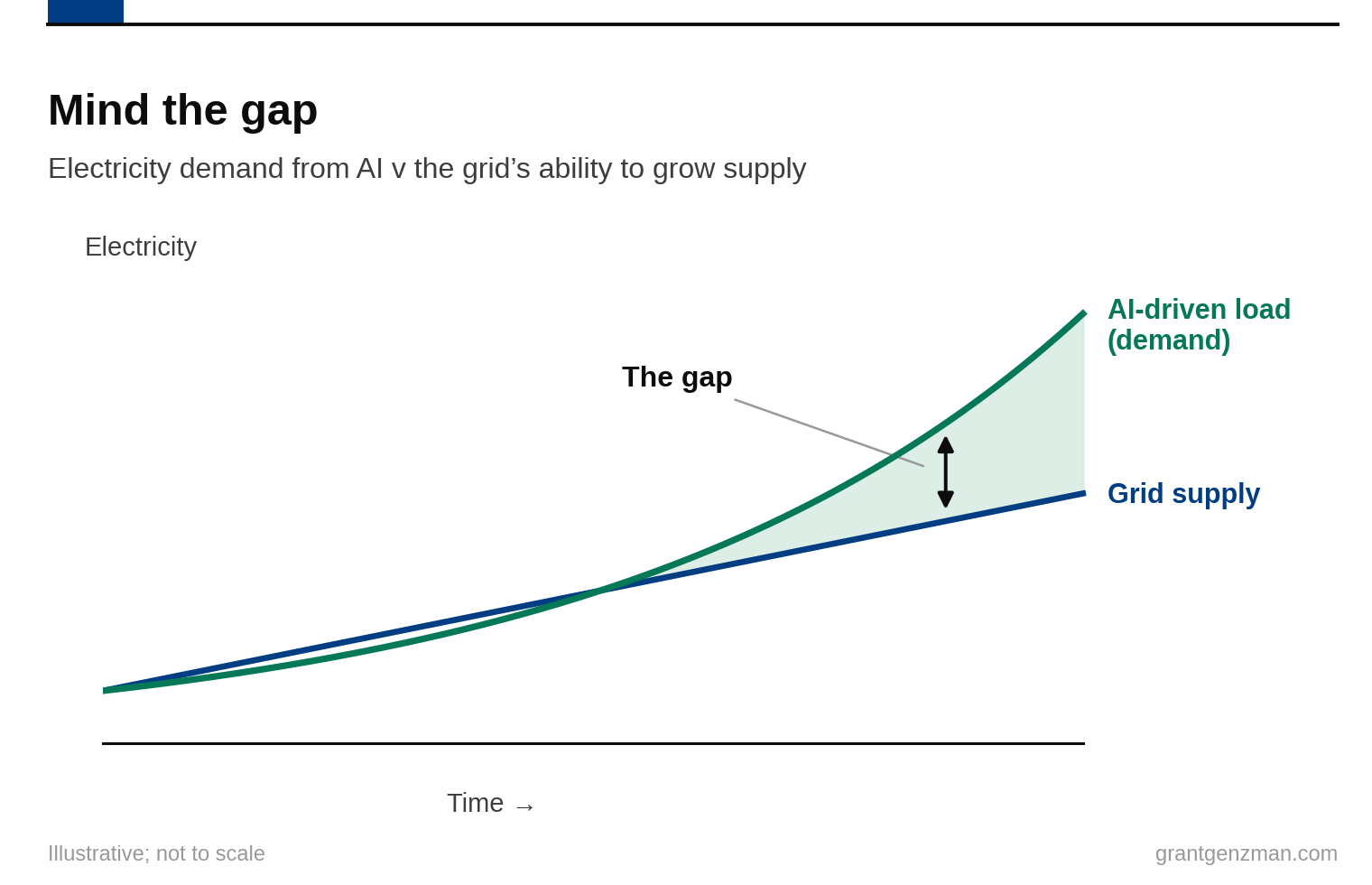
Here is the concern. Demand for AI—and therefore for electricity—can scale exponentially, because it is digital and increasingly lives at the edge on consumer hardware. The grid cannot grow at the same rate. Generation, transmission, and distribution grow roughly linearly, gated by supply chains, permitting, construction timelines, and the sheer physical complexity of the system. For a hundred years that growth rate was fine, and recent demand has been almost flat. Now demand is bending upward while supply plods along its old slope, and the gap between the two curves is where prices live. An increasing supply-demand mismatch means rising prices for electricity, and therefore for AI. We need better solutions to feed the hungry machines.
What the last nine months added
When I published the original essay in November 2025, one supply-side signal I had was GE Vernova’s disclosure of 62 GW of non-refundable gas turbine backlog and slot reservations—roughly five percent of total installed U.S. grid capacity, from one company.2 Nine months later that number is even larger. The backlog hit 100 GW in the first quarter of 2026 and 116 GW by the end of the second, with management now targeting at least 125 GW under contract by year-end—against annualized production of about 20 GW, meaning roughly five years of output is already committed.3 New orders are being priced ten to twenty percent above the late-2025 backlog, and the company expects its slots to be sold out through 2030 by the end of this year.4
The demand side keeps driving. U.S. electricity prices rose 6.9 percent in 2025—more than double headline inflation—with data centers accounting for roughly forty percent of electricity demand growth and analysts expecting several more years of above-inflation increases.5 Goldman Sachs now projects U.S. data center power demand climbing from 31 GW in 2025 to 41 GW in 2026 and 66 GW in 2027, with data centers’ share of peak summer demand doubling from about four percent to about eight and a half percent in two years.6 In PJM, the grid operator covering much of the mid-Atlantic and Midwest, the independent market monitor attributed record capacity prices primarily to data center load growth, putting the added cost to the 2025–26 delivery year at roughly $9.3 billion.7
The datacenter build-out funding has grown significantly: the five largest hyperscalers have guided to roughly $660–690 billion of combined capital expenditure in 2026, up from about $400 billion in 2025, with something like three-quarters of it aimed at AI infrastructure; global data center capex forecasts for the year now exceed $1 trillion.8 In response, investor-owned utilities have announced around $1.4 trillion of capital investment through 2030.9 Overall, datacenter demand is arriving faster than supply can be built. The constraint on datacenter AI is turning from model quality to watts.
What could bend the curve
All else being equal, what could soften this? Hardware keeps getting more efficient; TPUs and other application-specific chips are reportedly far more efficient for inference than general-purpose GPUs; unified-memory architectures are generally more efficient and changing the consumer equation; and further out, teams are working on entirely new computing paradigms that claim thousand-fold efficiency gains. That said, I am not yet convinced any of it develops and deploys fast enough to prevent significant supply-demand trouble in the meantime.
Footnotes
-
The Innovator’s Dilemma, Clayton Christensen, 1997. The Innovator’s Dilemma, The Innovator’s Solution ↩
-
GE Vernova Q3 2025 earnings call, October 22, 2025 (62 GW of non-refundable backlog and slot reservations), gevernova.com. ↩
-
Utility Dive, “GE Vernova gas turbine backlog climbs to 116 GW,” July 22, 2026; Turbomachinery Magazine, Q2 2026 earnings coverage (116 GW backlog, ≥125 GW year-end target, ~20 GW annualized output). ↩
-
Utility Dive, GE Vernova Q1 2026 earnings coverage, April 2026 (new orders priced 10–20% above Q4 2025 backlog; sold out through 2030 expected by end of 2026). ↩
-
Goldman Sachs research via CNBC, February 12, 2026 (electricity CPI +6.9% in 2025 vs. 2.9% headline inflation; data centers ~40% of electricity demand growth; ~6% further increases expected through 2027). ↩
-
Goldman Sachs Research, “US Data Center Power Demand Projected to Double by 2027,” May 2026 (31 GW in 2025 to 41 GW in 2026 and 66 GW in 2027; ~95 GW of capacity by end-2027; 4.1% to 8.5% of peak summer demand). ↩
-
PJM Independent Market Monitor, 2025 report (data center load growth the primary driver of record capacity market prices; ~$9.3 billion, or 174%, added to capacity costs for the 2025–26 delivery year), via PolitiFact, June 2026. ↩
-
Company guidance compiled from Q4 2025 / Q1 2026 earnings calls (Amazon, Microsoft, Alphabet, Meta, Oracle), via Futurum Group, February 2026 (~$660–690 billion combined 2026 capex); CreditSights estimates ~75% of hyperscaler capex is AI infrastructure; Dell’Oro Group raised its 2026 global data center capex outlook above $1 trillion (June 2026). ↩
-
Edison Electric Institute member capital plans via American Industrial Magazine, 2026 (~$1.4 trillion in announced investor-owned utility capital investment through 2030, up 27% from the prior-year projection). ↩