Triple Tightrope Walk
How the AI Bubble Pops
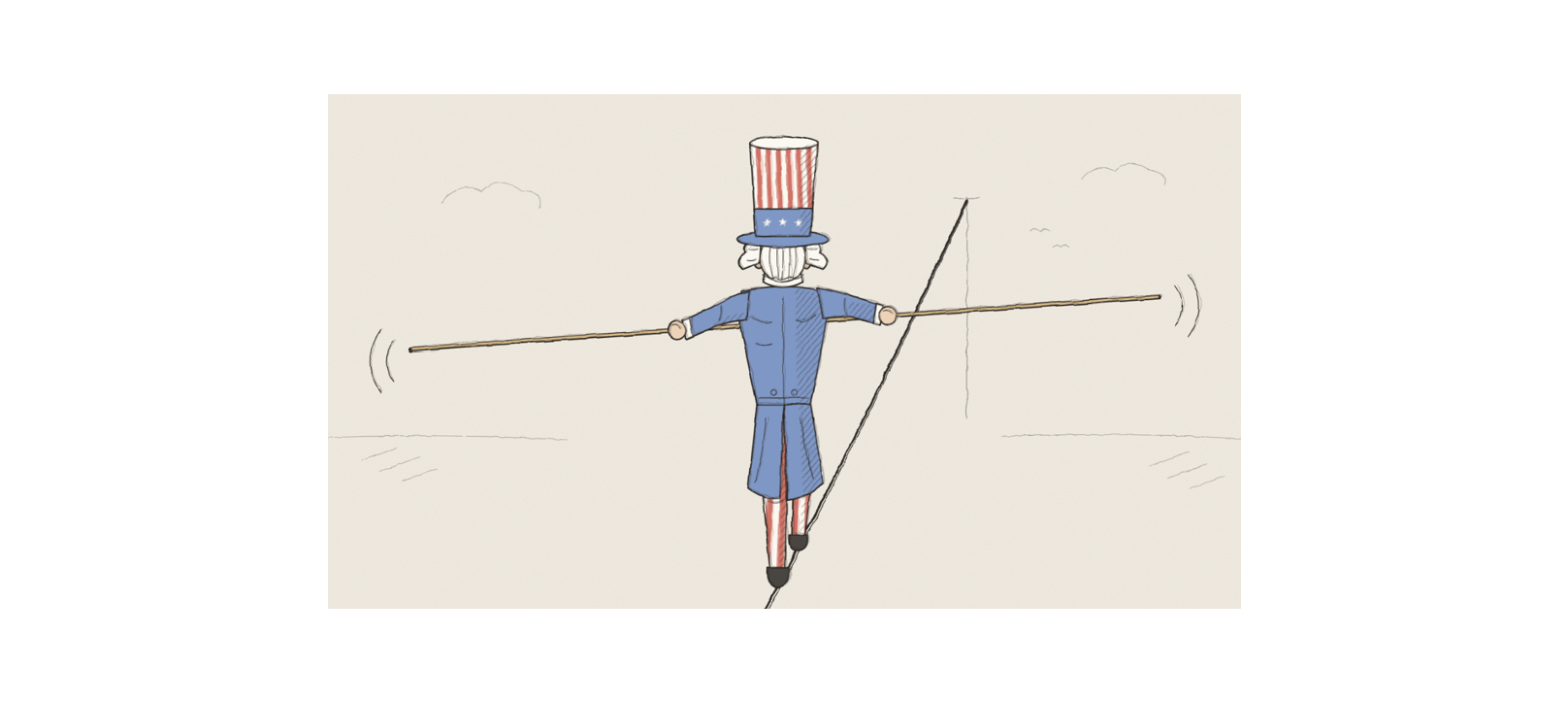
The stability of the economy rests on balancing three things: frontier AI development, adoption of AI for productivity, and AI running on local hardware. You can prepare yourself by learning how to build with AI and leaning into entrepreneurship.
We are at an inflection in the development and adoption of AI
For some, we are just past the honeymoon phase with LLMs—they’re great but we are also now applying recent advances to decision models, world models, voice, vision, and so on. Many others do not even realize we’ve been dating.
On the one hand, we have magic computers potentially running wild on the internet (HuggingFace, Australia), robot ducks walking and talking to people, and AI-controlled laboratories sequencing DNA and making new discoveries.
On the other hand, your boss is asking vague questions about how you are using AI, your team keeps giving you twice as much slop to read, and the biggest impact from these “magic computers” you’ve seen so far is a slightly more-informed search bar.
But the truth is that we are at a tipping point. In fact, we are at three. It’s a triple tightrope walk. In order to avoid some sort of economic crash, we must balance 1) model development with productivity growth, 2) productivity growth with unemployment, and 3) the datacenter buildout with edge and local model development. If we lean too far in any direction, our economy could be in for a bumpy ride.
Balancing model development vs. productivity growth
The frontier AI capabilities are improving rapidly, which should be good for innovation and productivity. But if the frontier capabilities grow faster than people can use them, people will turn to cheaper (even free) alternatives, leaving the frontier companies without buyers.
Frontier AI model labs like Anthropic and OpenAI are advancing very quickly. Not only do they have the best models in house and highly trained people using them, they may also be flirting with letting the models run free and improving themselves through recursive self-improvement (RSI). The frontier AI capabilities, typically developed in the United States, are advancing very fast. We’ve gone from writing to code to computer use to robotic laboratories in a matter of years. But if these capabilities get too good too fast, we may not know how to best use them. The leverage is less valuable if we cannot wield it.
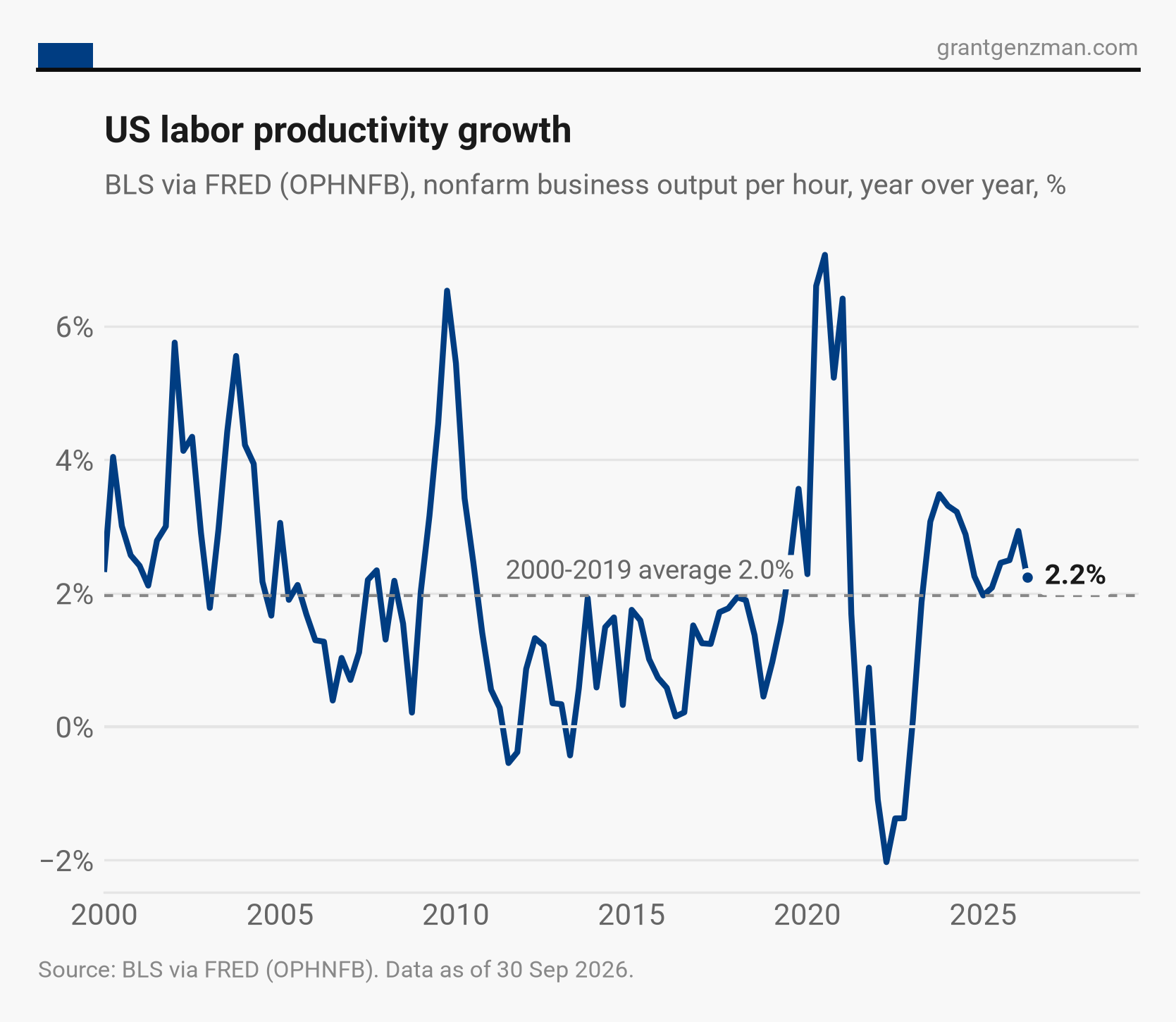
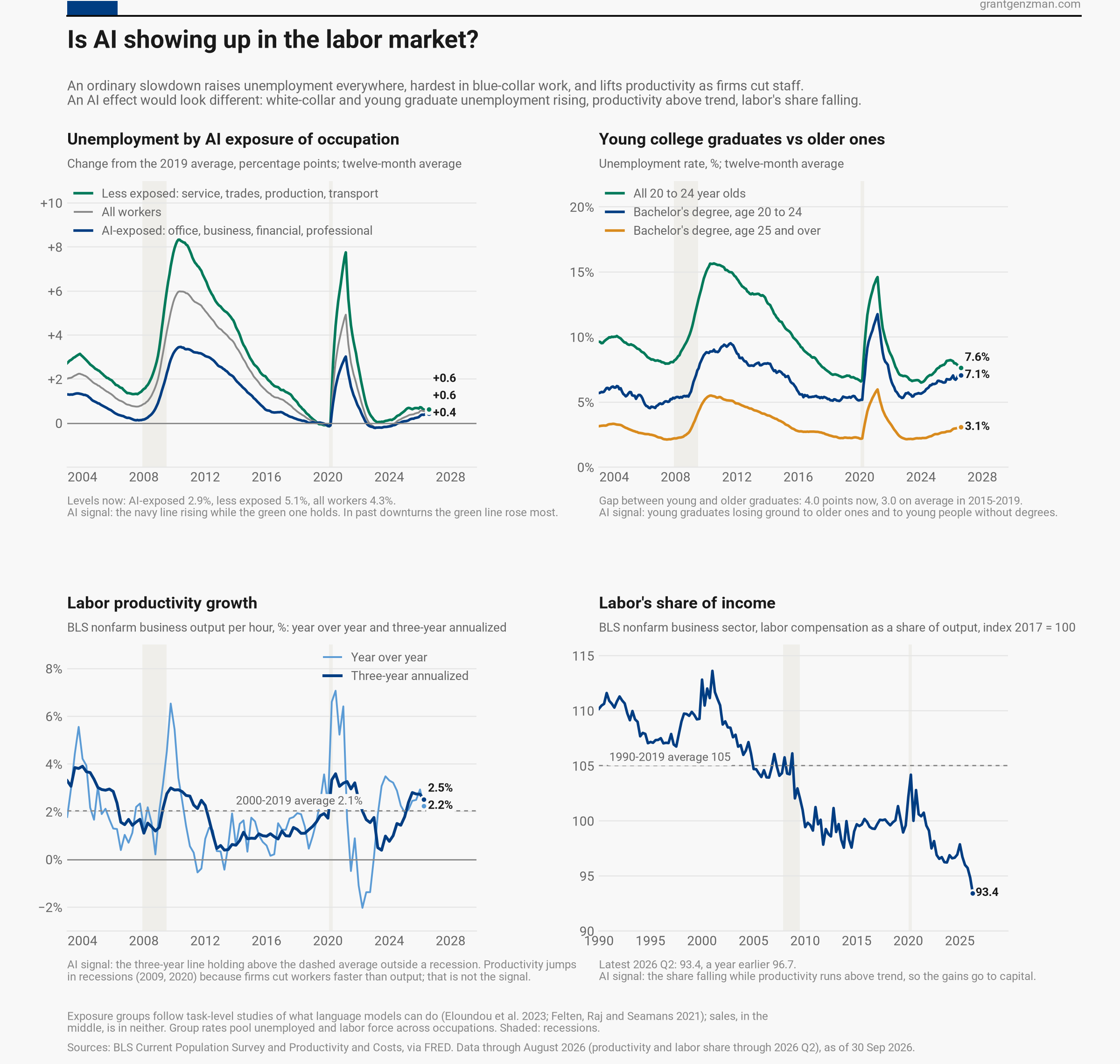
On the whole, we still seem to be struggling to get AI working well for us and yielding higher productivity. In mid-2025, MIT published a study saying only about 5% of companies saw positive return from their AI investments. If you look at productivity as recorded by the Bureau of Labor Statistics, there is no notable increase in the last few years.
If you look at the SP500, most of any recent gains are concentrated in the largest companies alone, as evidenced by the increasing ratio of SP500 by size relative to SP500 equally-weighted. And more obviously in daily life, many call centers are still not AI voice (and they still aren’t very helpful); people are still sending emails, writing slack messages, and holding meetings; robots aren’t doing laundry or making dinner—many may wonder “what’s the deal?”


The capability of the best-performing AI is growing extremely fast but the speed of companies and user adoption is very slow. As such, we could be experiencing a phenomenon coined by Harvard Business School strategy professor Clayton Christensen, known as the Innovator’s Dilemma. This dilemma exists for companies that provide a high-quality good or service—as they keep improving the quality, eventually they move beyond the actual need of their customers. At the same time, some competitor comes in who starts off at a lower quality—but also a lower price—and gradually improves, chipping away at the market until they own the majority of it.
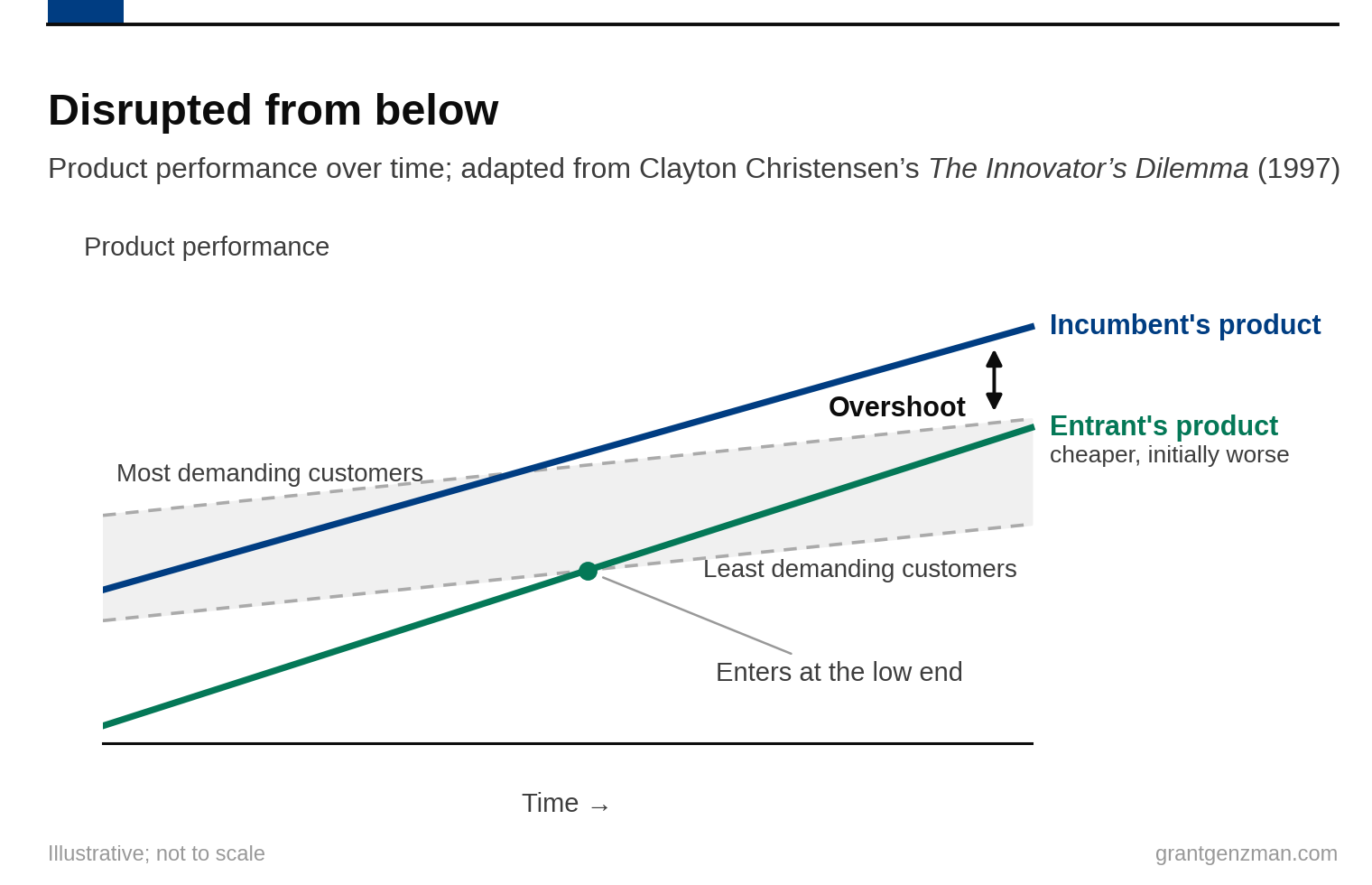
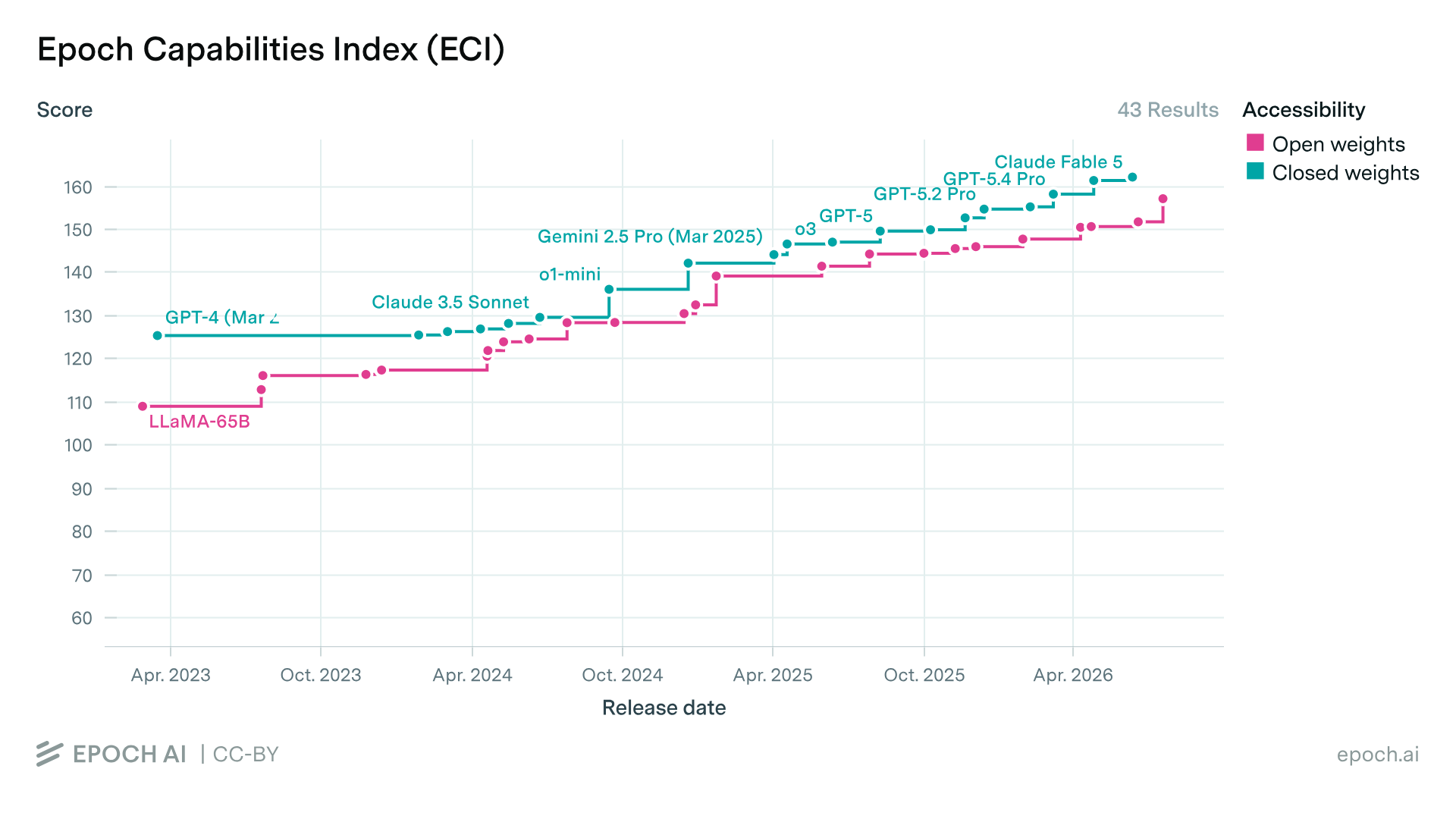
Right now, it may be that the frontier model companies—the companies carrying most of the hopes and dreams of investors (and the wider economy)—are advancing too quickly and are under attack from lesser products that are also improving rapidly. These “lesser” products are free, open-weight or open-source models, usually coming out of the People’s Republic of China. In performance and ability, they are only about six months behind the leading frontier models.
This capability absorption challenge could also explain the shift from model development to user-interface and model-harness development (Claude Code, Codex, Claude Cowork, Muse, Dots) over the last year. The leading companies have shifted focus beyond the underlying foundation models and on to figuring out how to get their products incorporated into daily lives. Rather than a pure focus on the underlying technology, they are working on the interfaces to connect to other apps and tools so people will use and pay for it.
This transition makes sense, because otherwise the high-end models could advance too fast, beyond the capacity of buyers to absorb the capability, leaving consumers with no willingness to pay for them. If that happens, they will lose market share to the cheaper open models from China. The problem is that user interfaces and app connections do not create much of an inherent moat, as evidenced by various open-source copies of similar agents and user tools (Pi, Hermes, OpenClaw, OpenCode, OpenWebUI). This competitive threat could be helping to motivate recent calls for slowing development at the frontier. Increased government regulation or development “speed limits” might help the current frontier leaders keep their relative winning positions while allowing them to slow their model-centric research and development.
Credit: Epoch AI
Balancing productivity growth vs. unemployment
Productivity growth would be good for the nation, but in the near term it could come at the expense of increased unemployment. Keeping employment stable would be good, but it should be balanced with productivity growth that keeps the nation internationally competitive.
It would be helpful for the frontier model companies if consumers and companies were better equipped to leverage the latest advances in AI; it would be helpful if they could absorb the product better. Optimizing for efficiency, it seems likely that humans will eventually no longer be needed for some of the most basic tasks, and certain jobs will evolve or maybe even disappear. Small teams leveraging AI aggressively could build and distribute new products that are comparable to those of existing traditional companies, probably even offering similar value at lower prices. We could see accelerated Schumpeterian creative destruction: as these AI-native competitors appear, some companies with traditional structures could struggle to survive.
From the high-level perspective, our economy and consumers would likely benefit from improved productivity due to advances in AI. In the long run, there will be better and cheaper products and services. But zooming in to the individual employee and company micro level, certain jobs and employment could be at risk. This will eventually balance out as people adapt, but in the near term, rapid productivity from AI could help AI-native companies win and lead to improved overall economic productivity metrics while still raising unemployment to unstable levels.
Balancing datacenter buildout vs. edge and local capability development
We are spending a massive amount on datacenter infrastructure to support AI. But the technology is improving rapidly, and it can be run on increasingly small machines. Free AI models that run on consumer laptops are currently as capable as the top-of-the-line frontier models from about six months ago. If everyone runs their own AI models at home, will we need all these datacenters? And what happens to the economy if we have overinvested, overleveraged, and overbuilt?
As the high-end frontier model companies advance, open-weight and open-source models advance as well, usually lagging capability by about six to 12 months. These freely available models are also often compressed down to work on smaller machines. Today, it is possible to download and run a free model, Qwen3.8-27B, on a $1000 five-year-old gaming computer and get an output essentially as good as that of the leading proprietary models from earlier this year. A free local model would have been nice, compared to paying $200 per month and still having usage limits.
It is reasonable to expect these smaller, cheaper models to continue developing, especially if the frontier model providers have to raise prices to cover expenses. As these free and local options improve, they could begin meeting most demands of consumers, especially if the users are slow to incorporate the latest frontier capabilities. But at what point does a large model hosted in a data center become unnecessary or even undesirable? And where does that leave an economy that is currently organizing itself around the compute provided by these centralized cloud servers? Given the latest local models, we may already have enough capability, but many businesses don’t have the tools to leverage it well.
We are watching three races unfold
I have concerns about economic stability as we move into the future, especially given high valuations and leverage. At some point local models and efficient model routing strategies become the bear case for the massive datacenter build-out, and maybe for the frontier labs as well.
In an economy currently built on the progress of AI, we are watching three races take place:
- rapid build out of datacenters serving cloud-based frontier models
- companies building their operations around AI (actual workflows and automation, not just employees prompting web chat bots for glorified search)
- open source and local models improving
In the above,
1 represents high-end supply,
2 is the demand that can pay for it,
3 are the lower-end products that chip away at that demand.
If either 1 or 3 move too fast, we’ve overbuilt and the economy struggles.
As you look to your own strategic positioning, keys to success in this future revolve around learning to harness this new technology and being prepared to make it on your own through entrepreneurship. I will be diving into more of that soon—follow along.